Migraine Botulinum Protocol
When headache days outnumber the good days - there is a structured, proven protocol
Chronic migraine is not "a lot of headaches." It is a neurological condition - 15 or more headache days a month, at least 8 of them migraine - that takes over work, family and sleep, and often drags a trail of painkillers behind it.
For this specific condition, botulinum toxin is one of the best-established preventive treatments in modern medicine: a fixed, evidence-based injection protocol, repeated every 12 weeks, that reduces the number of headache days for many patients.
At Team Clinic 360° in Herzliya, the protocol is administered by a specialist in anesthesiology and pain medicine, as part of a complete migraine care plan.
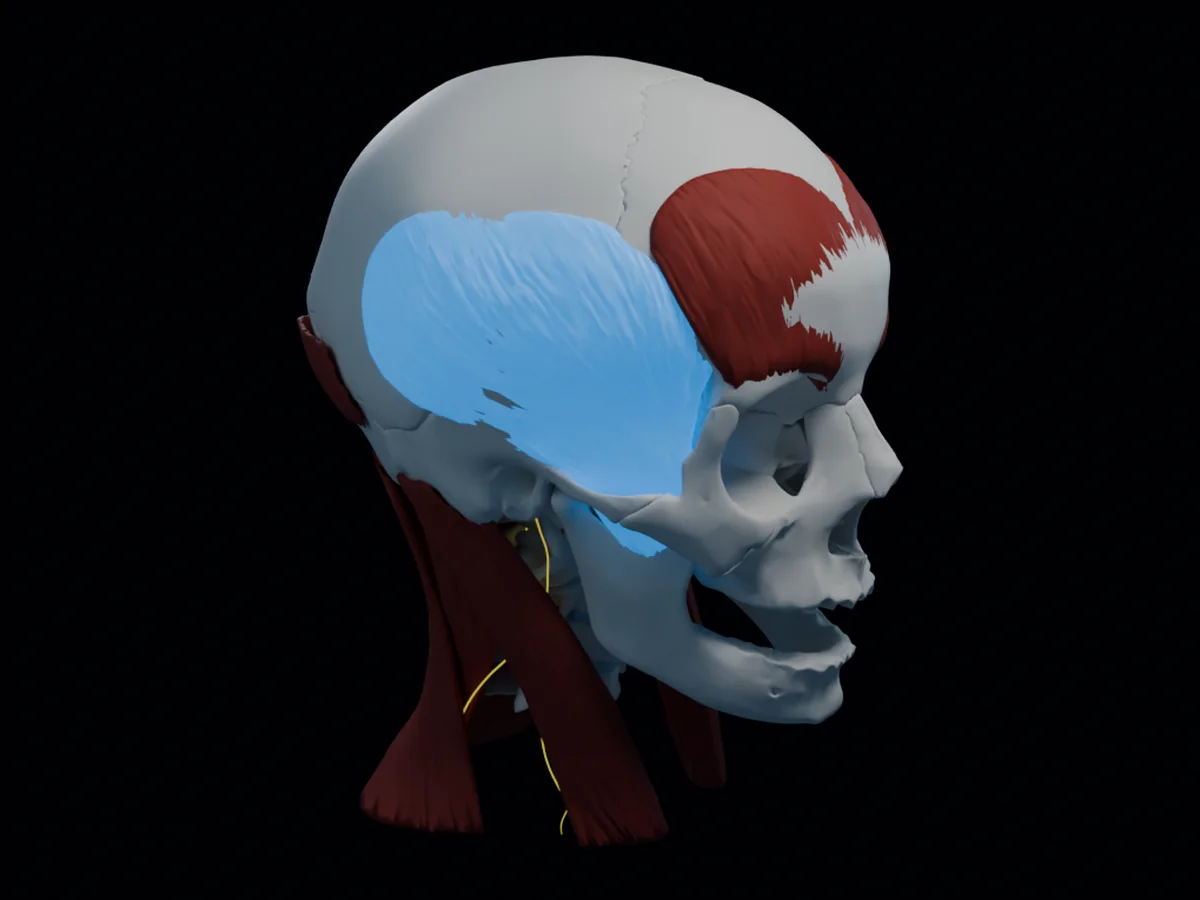
What the model shows: 3D model of the skull and the muscles of the head and neck in Julio, with the temporalis highlighted in blue alongside the frontalis, occipitalis, neck muscles and upper trapezius. Julio, Team Clinic 360° Anatomical detail: The muscles of the head and neck in Julio: the temporalis (blue), the frontalis, the occipitalis, the upper trapezius and the neck muscles. In the migraine protocol, the injection sites are defined in advance in these areas, not by where it happens to hurt that day. Interaction: this is an interactive 3D model from Julio. Once the 3D view loads it rotates automatically, unless the device is set to reduce motion. Drag to change the viewing angle and examine the anatomy from different sides; after you start interacting you can also zoom in and out.
The muscles of the head and neck in Julio: the temporalis (blue), the frontalis, the occipitalis, the upper trapezius and the neck muscles. In the migraine protocol, the injection sites are defined in advance in these areas, not by where it happens to hurt that day.
Anatomy model from Julio, the Team Clinic 360° digital atlas. Geometry sources: BodyParts3D © The Database Center for Life Science, CC BY-SA 2.1 JP; Z-Anatomy, CC BY-SA 4.0.
What exactly is the protocol?
The treatment follows the PREEMPT protocol - the injection scheme validated in the large clinical trials that led to FDA approval of botulinum toxin for chronic migraine. It consists of a series of small, superficial injections at fixed points across seven muscle regions of the head and neck: the forehead, temples, back of the head, neck and shoulder girdle.
The mechanism goes beyond relaxing muscles: botulinum toxin reduces the release of pain-signaling molecules from nerve endings involved in migraine - in effect, turning down the volume of the system that generates the attacks.
Who is a candidate?
- 15 or more headache days per month, for at least three months
- At least 8 of those days with migraine features
- Attacks that persist despite lifestyle measures and acute medications
- Patients who tried preventive medications and stopped due to side effects or lack of benefit
- Patients caught in medication-overuse headache - where the painkillers themselves perpetuate the cycle
Episodic migraine (fewer headache days) is treated differently - which is why the evaluation starts with a careful mapping of your headache pattern, sometimes with a simple headache diary.
What does a treatment cycle look like?
- A medical evaluation confirming the diagnosis of chronic migraine
- The injection session itself - a series of tiny injections with a very fine needle; typically 10-15 minutes
- Return to normal activity the same day
- Effect building over one to two weeks
- Repeat treatment every 12 weeks
Patience matters: clinical experience and the trial data both show that benefit often deepens over the second and third cycles. We track your headache days between cycles - the numbers, not impressions, guide the decisions.
What results can be expected?
In the pivotal trials, patients receiving botulinum toxin had a significant reduction in monthly headache days compared with placebo, and a meaningful share of patients achieve a 50% or greater reduction over successive cycles. Many describe something simpler: fewer lost days, less fear of the next attack, less reliance on painkillers.
It is preventive treatment - it will not abort an attack in progress - and it works best inside a complete plan: trigger management, sleep, acute-medication strategy and, when relevant, additional preventive options.
Migraine care at Team Clinic 360°
The protocol is performed by Dr. Lior Shem Tov, specialist in anesthesiology and pain medicine, with Dr. Natalie Siegel coordinating the broader picture - medications, comorbidities, and everything the migraine has been dragging with it. When neck and shoulder muscles feed the attacks, treatments such as medical dry needling or nerve blocks can be combined.
Fifteen headache days a month is not a lifestyle - it is a diagnosis
If migraine is dictating your calendar and the painkillers are barely keeping up, a structured evaluation can determine whether the botulinum protocol fits your case.
To schedule a chronic-migraine evaluation - contact us by phone or WhatsApp.
Frequently asked questions
How is this different from cosmetic Botox?
Different goal, different map, different doses. The migraine protocol involves fixed injection points across the head, neck and shoulders, validated in clinical trials for reducing headache days - not for appearance.
Does the treatment hurt?
The injections are superficial, with an extremely fine needle, each lasting a second. Most patients rate the discomfort as minimal - far less than a migraine day.
When will I feel the effect?
Typically within one to two weeks of the first cycle, with benefit often building over the second and third cycles. That is why we commit to a fair trial of two to three cycles before judging.
Are there side effects?
Usually mild and temporary - small bruises, brief neck soreness, rarely a temporary heaviness of the eyelid or brow. Serious effects are rare, and everything relevant is discussed before treatment.
Can I continue my migraine medications?
Yes. The protocol is preventive and works alongside acute medications; in many patients it reduces how often those medications are needed. The full plan is coordinated by the physician.
What if botulinum toxin is not right for me?
Then the evaluation will say so honestly - and map the alternatives, from modern preventive medications to treating the neck and muscle contributors that sometimes drive the attacks.
Medical sources for further reading
The information on this page is intended as general background and does not replace personal medical advice.
The information on this page is general in nature and does not replace a personal medical diagnosis, consultation or treatment. Any treatment is tailored only after a medical evaluation, at the physician's discretion.