Myofascial Pain Syndrome
When the muscle hurts - but the problem runs deeper than a "tight muscle."
Myofascial pain is one of the most common, and most often misdiagnosed, causes of persistent pain.
Many patients describe it as a back that will not release, a neck that radiates to the head, deep shoulder pain, pressure between the shoulder blades, or pain that radiates to an arm or leg - and sometimes pain that feels as if it comes from somewhere else entirely.
Often the tests do not tell the whole story. An MRI may show a finding, an X-ray may look normal, and the patient still suffers real, limiting, ongoing pain. In such cases it is important to check whether the source is myofascial - pain coming from muscles, connective tissue, and trigger points.
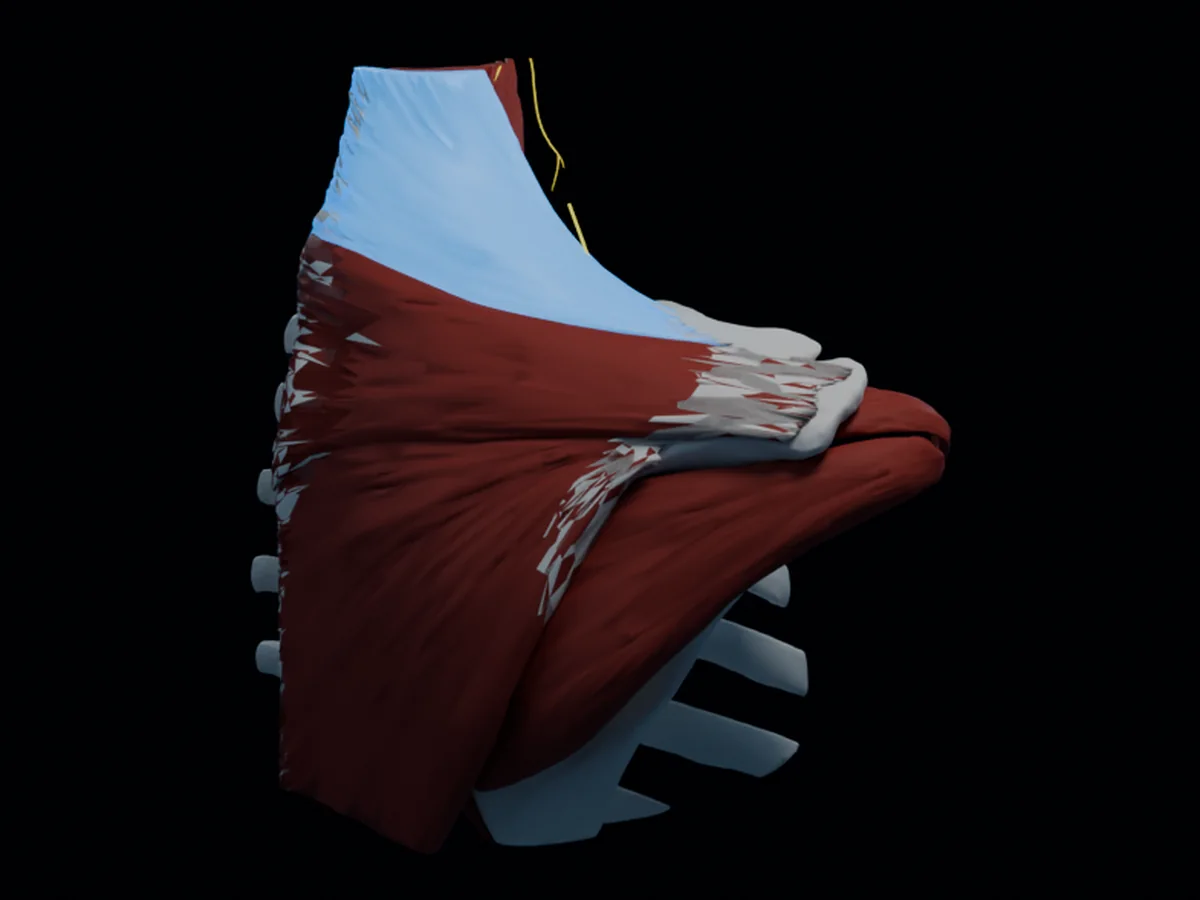
What the model shows: 3D model of the neck, shoulder blades and upper back in Julio, with the upper trapezius highlighted in blue and the levator scapulae, rhomboids and shoulder-blade muscles visible around it. Julio, Team Clinic 360° Anatomical detail: The muscles of the neck, shoulder blade and upper back in Julio: the upper trapezius (blue), and beneath it the levator scapulae, the rhomboids and the shoulder-blade muscles. Interaction: this is an interactive 3D model from Julio. Once the 3D view loads it rotates automatically, unless the device is set to reduce motion. Drag to change the viewing angle and examine the anatomy from different sides; after you start interacting you can also zoom in and out.
The muscles of the neck, shoulder blade and upper back in Julio: the upper trapezius (blue), and beneath it the levator scapulae, the rhomboids and the shoulder-blade muscles.
Anatomy model from Julio, the Team Clinic 360° digital atlas. Geometry sources: BodyParts3D © The Database Center for Life Science, CC BY-SA 2.1 JP; Z-Anatomy, CC BY-SA 4.0.
What is myofascial pain?
Myofascial pain originates in the muscular system and the connective tissue (fascia) that wraps and supports the muscles. Its central feature is the appearance of trigger points - sensitive, contracted, or irritable spots within a muscle that can cause local pain and pain that radiates elsewhere.
In other words, the problem is not always located where you feel the pain. A trigger point in the neck can refer to the head; one in the shoulder can feel like arm pain; one in the lower back or pelvis can refer to the buttock or leg. Sometimes pain that looks like a disc, nerve, or joint problem actually begins in a muscle.
Signs that may fit myofascial pain
- Deep, pressing, or burning pain inside the muscle
- A feeling of a "knot" or a tight area that will not release
- Pain that radiates to another area
- Worsening with prolonged sitting, desk work, or repetitive strain
- Pain in the neck, shoulder blades, lower back, pelvis, shoulder, or jaw
- Headaches originating in the neck or shoulder blades
- Reduced range of motion and morning stiffness
- Pain that eases briefly with massage, heat, or stretching - then returns
- Strong tenderness when pressing a specific point in the muscle
Trigger points - small points, large effect
A trigger point is a highly sensitive area within a tense or irritated muscle. Sometimes it feels like a small knot; sometimes only precise pressure reveals that it reproduces the pain the patient knows. If pressing a specific point reproduces the patient usual pain or its referral, it can give a meaningful clue to the source. Instead of treating only where the pain is felt, the point that drives it must be found.
Our approach at Team Clinic 360°
Myofascial pain calls for a physician who understands pain, not only muscles. Our evaluation starts with listening and a thorough exam: how the pain began, what worsens and eases it, where it radiates, what has been tried, what the imaging shows, and what truly limits the patient day to day. When suitable, we combine the clinical exam with ultrasound assessment. The goal is not just to "do a treatment," but to understand what is holding the pain in place - and then build a plan to take it apart.
Treatment of myofascial pain
Treatment varies from patient to patient; there is no single solution. In suitable cases, a plan may include:
- A pain physician evaluation
- Assessment of trigger points and referral patterns
- Dry needling for trigger points
- Trigger point injections where needed
- Ultrasound-guided treatment when appropriate
- Gradual movement and function rehabilitation
- Work on posture, load, and movement habits
- Complementary physical therapy
- Adjusting medication where needed
- Addressing factors that sustain the pain - sleep, stress, repetitive load
Common areas for myofascial pain
Neck and shoulder blades
Neck pain, pressure between the shoulder blades, and pain radiating to the head, temple, shoulder, or arm.
Lower back and pelvis
Deep back pain and pain radiating to the buttock or leg, sometimes resembling disc or nerve pain.
Shoulder and arm
Pain that limits lifting the arm, radiates along the arm, or feels like burning around the shoulder.
Jaw and face
Pain around the jaw, temple, ear, or head, sometimes with muscle overload or teeth grinding.
Hip and knee
Pain that feels like a joint problem, but may originate in the muscles around the pelvis, hip, or knee.
Frequently asked questions
Is myofascial pain just a tight muscle?
Not exactly. A tight muscle can release quickly. Myofascial pain can become a more persistent state, with trigger points, referred pain, limited movement, and pain that keeps returning.
Can myofascial pain be seen on an MRI?
Usually not directly. An MRI can help rule out or identify other problems, but myofascial pain is diagnosed mainly from the medical story and the physical examination.
What is a trigger point?
A sensitive area within a muscle where pressure can cause local pain or pain that radiates elsewhere. Sometimes it is the point that drives the whole pain pattern.
Can dry needling help?
In suitable cases, dry needling of trigger points can be part of the plan. The decision depends on the location, the examination, your medical condition, and what has already been tried.
Can it feel like a herniated disc?
Yes. Myofascial pain can radiate and mimic nerve pain or spine-related pain, which is why an accurate diagnosis matters and the sense of referral alone should not be relied upon.
Is one treatment enough?
Sometimes there is quick improvement, but chronic cases usually need a broader plan: treating trigger points, improving movement, reducing load, and addressing factors that bring the pain back.
Do you promise the pain will go away?
No. There are no medical guarantees. The goal is an accurate diagnosis, understanding the pain mechanism, choosing a suitable treatment, and improving pain, movement, and function as much as possible.
You do not have to live with this alone
If pain keeps returning, the muscle will not release, or imaging does not explain the intensity, you are welcome to schedule an evaluation at Team Clinic 360° in Herzliya to look for the source.
The information on this page is general and does not replace personal medical advice. In an emergency or with unusual worsening, please seek appropriate medical care immediately.
Further reading: Persistent Low Back Pain · Radiating Leg Pain · Radiating Arm Pain