Golfer's Elbow
When the inner side of your elbow hurts with every grip, lift and turn
Golfer's elbow is the lesser-known sibling of tennis elbow - pain on the inner side of the elbow, usually in people who have never held a golf club.
At first it is a small ache after activity. Then it hurts to lift a weight, carry groceries, open a door, shake hands. Sometimes tingling or an electric sensation appears in the fingers. And at some point, the arm simply stops cooperating.
Many patients are told: "It's just a strained muscle." "Rest and it will pass." "It's inflammation, take a pill."
Sometimes that is true. But when the pain lasts weeks and months, returns with every effort, or comes with neural symptoms - it is time to stop and get an accurate diagnosis.
At Team Clinic 360° we approach golfer's elbow as a condition that calls for a precise diagnosis, an understanding of the state of the tendon, and a plan that combines pain control, load management and graded rehabilitation.
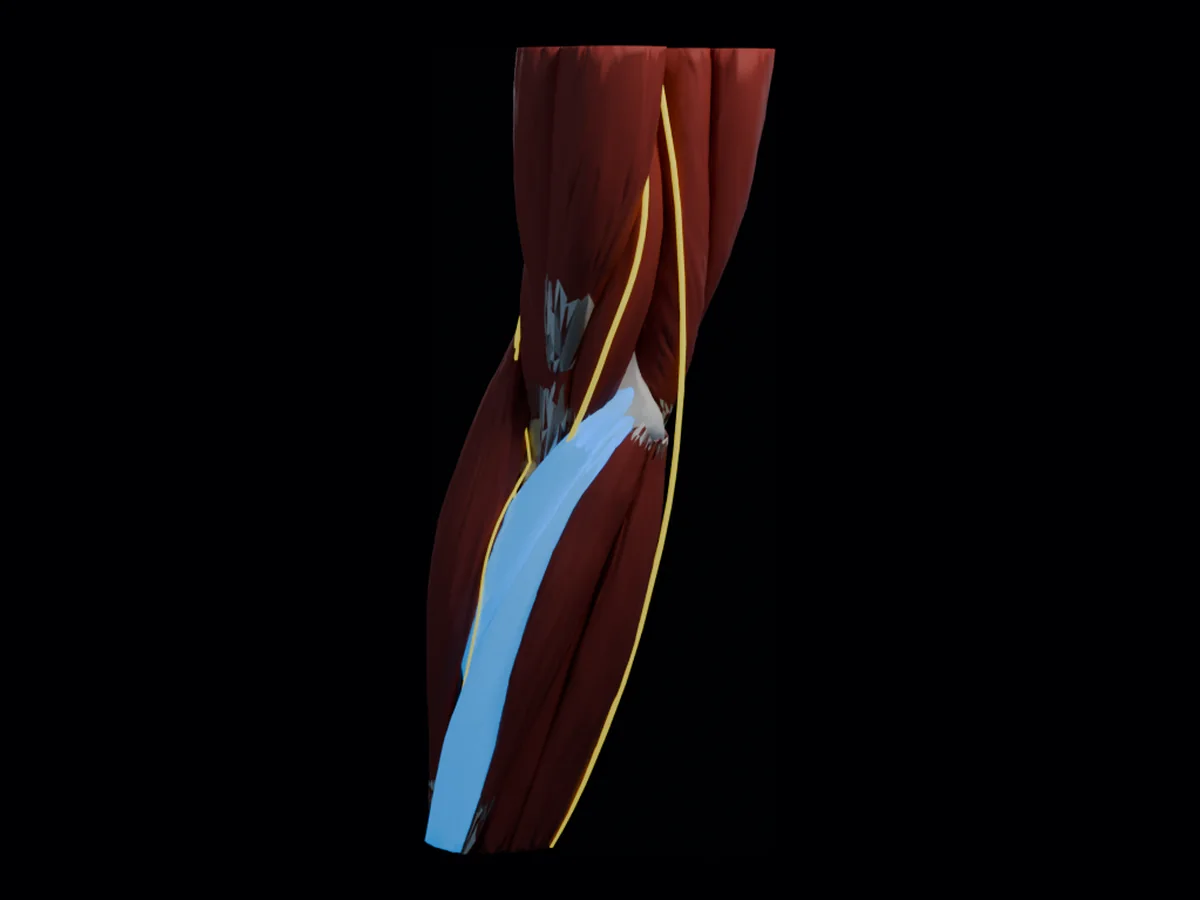
What the model shows: 3D model of the inner side of the right elbow in Julio: the flexor and pronator muscles, their tendons and ligaments, with the pronator teres and FCR highlighted in blue and the ulnar nerve visible close by. Julio, Team Clinic 360° Anatomical detail: In blue: the pronator teres and the flexor carpi radialis (FCR), which attach together with other muscles at the common flexor origin on the inner bony bump of the humerus. In yellow beside them: the ulnar nerve. Interaction: this is an interactive 3D model from Julio. Once the 3D view loads it rotates automatically, unless the device is set to reduce motion. Drag to change the viewing angle and examine the anatomy from different sides; after you start interacting you can also zoom in and out.
In blue: the pronator teres and the flexor carpi radialis (FCR), which attach together with other muscles at the common flexor origin on the inner bony bump of the humerus. In yellow beside them: the ulnar nerve.
Anatomy model from Julio, the Team Clinic 360° digital atlas. Geometry sources: BodyParts3D © The Database Center for Life Science, CC BY-SA 2.1 JP; Z-Anatomy, CC BY-SA 4.0.
What is golfer's elbow?
Golfer's elbow, or medial epicondylitis, is an overuse injury of the wrist and finger flexor tendons at their attachment to the bony prominence on the inner side of the elbow. According to the Mayo Clinic, the pain centers on the inner elbow and can radiate down the forearm.
As with tennis elbow, the name is misleading: most patients do not play golf. The condition is common in anyone who performs repetitive gripping and wrist-flexing motions - manual labor, weight training, climbing, working with tools, even carrying children and shopping bags.
And as with tennis elbow, in most cases this is not an acute inflammation but a process of tendon degeneration and overload - which is why "an anti-inflammatory pill" alone is not a treatment plan.
What does golfer's elbow feel like?
Patients with golfer's elbow often describe:
- Pain or tenderness on the inner side of the elbow
- Pain radiating down the forearm toward the wrist
- Pain with a strong grip or handshake
- Pain when lifting objects or weights
- Pain when turning the hand - opening a jar, using a screwdriver, turning a handle
- Morning stiffness in the elbow
- Weakness of grip
- Sometimes numbness or tingling in the ring and little fingers
That last point matters: the ulnar nerve runs right next to the affected area. In some cases it becomes irritated as well - and that changes the treatment picture. StatPearls notes that ulnar nerve symptoms accompany a meaningful share of medial epicondylitis cases.
Why does an accurate diagnosis matter?
Not every pain on the inner side of the elbow is golfer's elbow.
Pain in this region can also come from ulnar nerve entrapment (cubital tunnel syndrome), from the elbow's inner ligament, from the joint itself, from the neck radiating down the arm, or from myofascial pain in the forearm muscles. And sometimes the pain is actually on the outer side - tennis elbow - or on both sides at once.
The difference matters, because the treatment is not the same.
With golfer's elbow we need to understand: Is the problem limited to the tendon? Is the ulnar nerve involved? Is there a cervical component? And which treatment fits the stage - conservative care, medical dry needling, prolotherapy, an ultrasound-guided injection, or hydrodissection of the nerve in suitable cases?
An accurate diagnosis saves time, pain, and treatments aimed at the wrong target.
Why "waiting for it to pass" is not always enough
It is true that most cases of golfer's elbow improve with conservative care. But the process can take months, and time alone is not a treatment plan.
While waiting, a patient may go through persistent pain, declining grip strength, an impact on work and training, and a growing tendency to avoid using the arm.
More than that - uncontrolled load on an irritated tendon perpetuates the problem, while complete and prolonged rest weakens the tendon and muscles. And if an unrecognized ulnar nerve problem is part of the picture, the "standard" treatment simply will not work.
That is why the key is an accurate diagnosis, correct load management, pain control and gradual strengthening.
Our approach at Team Clinic 360°
At Team Clinic 360° we do not look at golfer's elbow as just another "sore elbow."
We look at the whole picture:
- How the pain began - suddenly or gradually
- Which activities make it worse and which ease it
- How long the problem has been present and what has already been tried
- The nature of your work, sport and daily load on the arm
- Whether there is numbness, tingling or weakness in the fingers
- Whether the ulnar nerve is involved
- Whether the neck or shoulder are part of the picture
- Grip strength and overall function
The exam includes a focused clinical evaluation, specific tendon loading tests, a neural exam as needed, and at times the use of diagnostic ultrasound - to assess both the tendon and the nerve and rule out other problems.
Your evaluation and treatment are led by Dr. Lior Shem Tov, a specialist in anesthesiology and pain medicine, and Dr. Natalie Siegel, a specialist in family and pain medicine.
Treatment for golfer's elbow
Treatment for golfer's elbow depends on how long the problem has been present, the intensity of pain, the condition of the tendon, whether the nerve is involved, and your medical background.
In suitable cases, treatment options may include:
- Assessment by a pain physician and a full clinical evaluation
- Diagnostic ultrasound as needed
- Load management - at work, in sport and in daily life
- Medication to reduce pain, when appropriate
- Physical therapy focused on graded strengthening of the flexor tendons
- Ultrasound-guided medical dry needling of the tendon region and forearm muscles
- Prolotherapy - injections aimed at stimulating a healing response in the tendon
- Ultrasound-guided injections in suitable cases
- Treatment of the ulnar nerve, including ultrasound-guided hydrodissection, when the nerve is involved
- A structured, graded home exercise program
In golfer's elbow, precision matters twice over: the ulnar nerve runs immediately next to the treatment area, so any injection in this region should be performed carefully - and preferably under ultrasound guidance.
There is no single treatment that fits everyone. There is a tendon. There is a nerve. There is a person. And there is a plan that has to fit them.
Golfer's elbow or a nerve problem?
This is one of the most important distinctions on the inner side of the elbow.
Tendon pain worsens with gripping and with wrist flexion against resistance. Ulnar nerve entrapment, by contrast, usually causes numbness and tingling in the ring and little fingers, sometimes with subtle weakness of the hand. And sometimes - both problems exist together.
The neck can confuse the picture as well: pressure on a cervical nerve root can radiate pain and numbness down the arm into the fingers.
That is why, in our exam, we do not stop at the tendon. We examine the nerve, the neck and the pattern of pain - because precise treatment starts with the right address.
When should you come in for an evaluation?
It is worth considering a visit to a pain physician or a clinic that focuses on pain if:
- Pain on the inner side of the elbow has lasted more than a few weeks
- The pain returns every time you go back to activity
- Your grip strength is declining
- There is numbness or tingling in the ring and little fingers
- The pain interferes with work, training or sleep
- Rest and painkillers have not brought stable improvement
- You had an injection and the pain came back
- It is unclear whether the problem is the tendon, a nerve or the neck
What happens at the appointment?
At the appointment we carry out a medical evaluation aimed at understanding whether this is golfer's elbow, the state of the tendon, whether the nerve is involved, and whether other factors are part of the picture.
The appointment may include:
- An in-depth medical conversation
- A clinical exam of the elbow, forearm and wrist
- Specific tendon loading tests
- A neural exam of the ulnar nerve as needed
- Examination of the neck, shoulder and radiating areas as needed
- Diagnostic ultrasound based on clinical need
- Review of previous tests and imaging
- Evaluation of suitability for conservative care, dry needling, prolotherapy, an injection or hydrodissection
- Building a clear treatment direction
The goal is for you to leave with an understanding: what is happening in the elbow, what the true source of the pain is, and what can be done now.
What to bring to the appointment
We recommend coming with:
- Previous visit summaries
- Ultrasound / MRI / EMG / X-ray reports, if you have them
- A list of medications and treatments you have tried
- A short summary: when the pain started, what makes it worse, what eases it, and what you can no longer do
- Records of physical therapy, injections or previous treatments, if any
Golfer's elbow - you do not have to learn to live with it
Golfer's elbow can drag on for months and wear down your daily life - your work, your training, and the simplest everyday tasks. But in most cases, with an accurate diagnosis and the right treatment, you can get past it.
If the inner side of your elbow has been hurting for weeks, your grip is getting weaker, your fingers are tingling, or the treatments so far have not given a clear direction - it is worth stopping and looking at it properly.
At Team Clinic 360° we will examine the elbow in depth, assess both the tendon and the nerve, and build a treatment plan matched to your stage, your pain and your function.
To schedule a medical evaluation for golfer's elbow - leave your details and we will get back to you shortly.
Frequently asked questions
What exactly is golfer's elbow?
Golfer's elbow (medial epicondylitis) is an overuse injury of the wrist and finger flexor tendons where they attach to the inner side of the elbow. It is a process of tendon degeneration and overload rather than an acute inflammation or a sudden tear.
I do not play golf - how do I have golfer's elbow?
Most patients with golfer's elbow do not play golf. Any repetitive gripping and wrist-flexing motion - manual labor, weight training, climbing, working with tools, carrying bags and children - can overload the tendons and cause the problem.
What is the difference between golfer's elbow and tennis elbow?
Golfer's elbow affects the tendons on the inner side of the elbow; tennis elbow affects the tendons on the outer side. The mechanism is similar - an overload injury of the tendon - but golfer's elbow is less common and is sometimes accompanied by irritation of the ulnar nerve.
Does golfer's elbow go away on its own?
Often yes, but the process can take months. The right treatment can shorten the course, control the pain, preserve strength and function - and, importantly, make sure a nerve problem is not being missed.
Why are my ring and little fingers tingling?
The ulnar nerve runs right next to the affected area. When it is irritated or entrapped, it causes numbness and tingling in the ring and little fingers, and sometimes subtle hand weakness. This is an important sign to evaluate, because it changes the treatment plan.
Should I get a corticosteroid injection?
An injection can ease pain in the short term, but it does not heal the tendon, and in this region it requires special caution because of the nearby ulnar nerve. The decision requires medical judgment, and any injection here is best performed under ultrasound guidance.
Do I need an MRI or EMG to diagnose golfer's elbow?
In most cases, no. The diagnosis is clinical, and ultrasound is sometimes used to assess the tendon and the nerve. EMG is reserved for cases with real suspicion of nerve involvement, and MRI for complex or unclear cases.
Can I keep training with golfer's elbow?
Usually yes, with modifications. The idea is to manage load: temporarily reduce the exercises that flare the pain, stay active, and build back gradually while strengthening the tendons. Complete, prolonged rest actually weakens the tendon.
Is surgery required for golfer's elbow?
Almost never. The vast majority of patients improve with nonsurgical care. Surgery is considered only in resistant cases, after a prolonged and comprehensive course of treatment has failed.
Medical sources for further reading
The information on this page is intended as general background and does not replace personal medical advice. For further reading, see professional medical sources.