Ultrasound-Guided Dry Needling
Releasing the muscle knots that keep firing pain - with a needle, not a pill
Some of the most stubborn pain does not come from a joint or a disc. It comes from the muscles themselves - from taut bands and trigger points that develop after overload, injury or prolonged tension, and keep generating pain long after the original cause has passed.
Medical dry needling targets these points directly: a fine needle deactivates the trigger point, releases the taut band, and interrupts the pain cycle.
At Team Clinic 360° in Herzliya, dry needling is performed by a specialist physician - and when the target is deep or close to sensitive structures, under ultrasound guidance.
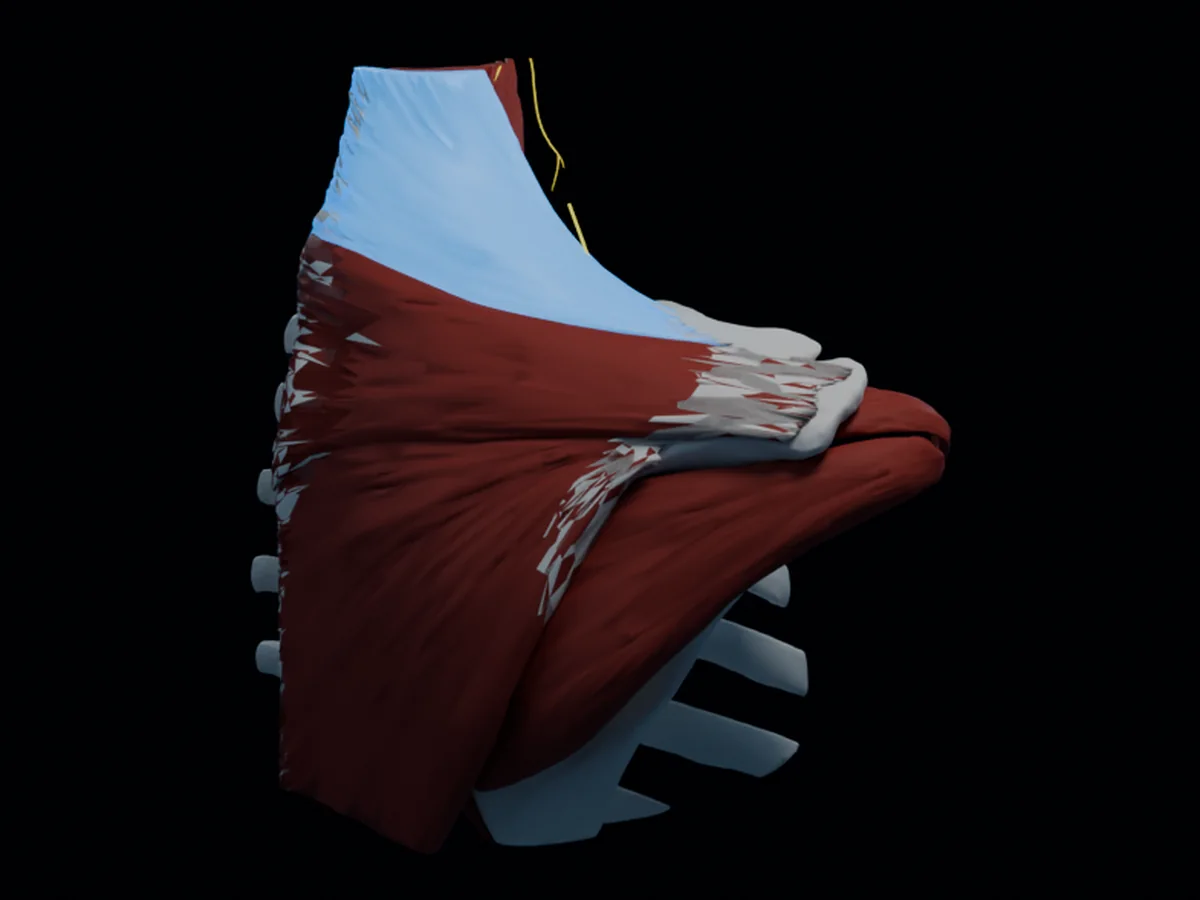
What the model shows: 3D model of the neck, shoulder blades and upper back in Julio, with the upper trapezius highlighted in blue and the levator scapulae, rhomboids and shoulder-blade muscles visible around it. Julio, Team Clinic 360° Anatomical detail: The muscles of the neck, shoulder blade and upper back in Julio: the upper trapezius (blue), and beneath it the levator scapulae, the rhomboids and the shoulder-blade muscles. These layers sit on top of one another, which is why ultrasound helps confirm the depth of the needle. Interaction: this is an interactive 3D model from Julio. Once the 3D view loads it rotates automatically, unless the device is set to reduce motion. Drag to change the viewing angle and examine the anatomy from different sides; after you start interacting you can also zoom in and out.
The muscles of the neck, shoulder blade and upper back in Julio: the upper trapezius (blue), and beneath it the levator scapulae, the rhomboids and the shoulder-blade muscles. These layers sit on top of one another, which is why ultrasound helps confirm the depth of the needle.
Anatomy model from Julio, the Team Clinic 360° digital atlas. Geometry sources: BodyParts3D © The Database Center for Life Science, CC BY-SA 2.1 JP; Z-Anatomy, CC BY-SA 4.0.
What is medical dry needling?
"Dry" means that nothing is injected - the therapeutic effect comes from the needle itself. Inserted precisely into a trigger point, the needle produces a brief local twitch response, after which the taut muscle band relaxes, local blood flow improves, and the pain signal quiets down.
Despite the superficial resemblance, this is not acupuncture. Dry needling is a Western medical technique based on the anatomy and physiology of muscle and fascia, aimed at findings the examiner can actually palpate - not at traditional energy meridians.
When is dry needling considered?
- Myofascial pain and trigger points - neck, shoulder girdle, back, hips
- Tension-type headaches driven by neck and shoulder muscles
- Muscle pain that mimics joint or nerve pain
- Chronic overload in athletes and manual workers
- Alongside tendon problems such as tennis elbow and golfer's elbow, where the forearm muscles are part of the pain
- As part of a broader plan for fibromyalgia and widespread pain, in selected cases
The precondition, as always, is diagnosis: confirming that the muscle is truly the pain generator - and not a nerve, joint or referred pain from elsewhere.
Why ultrasound guidance?
Superficial trigger points can be treated by palpation. But deeper muscles - and any region near the lung, blood vessels or nerves - are a different story.
Under ultrasound the physician sees the muscle layers, the needle and the surrounding structures in real time. That allows treatment of deep trigger points that manual palpation cannot reach reliably - with a level of safety that blind needling cannot offer.
What happens at the appointment?
- Review of your story and previous treatments
- A hands-on examination mapping the taut bands and trigger points
- Ultrasound assessment when deep muscles are involved
- The needling itself - each point takes seconds to a couple of minutes
- Simple aftercare: gentle movement and hydration; strenuous training is best deferred to the next day
A brief muscle-ache sensation for a day or two after treatment is common and expected - similar to the feeling after a hard workout. Relief typically emerges as that fades.
Dry needling within a real plan
Needling releases the trigger point - but if the muscle is overloaded by posture, work habits, weak neighboring muscles or an untreated joint problem, the trigger point will return.
That is why at Team Clinic 360° dry needling is always embedded in a plan: correcting the driver, restoring strength and movement, and combining treatments - from guided injections to rehabilitation - when the picture calls for it.
Treatment is performed by Dr. Lior Shem Tov, specialist in anesthesiology and pain medicine, with the overall plan coordinated by Dr. Natalie Siegel.
Muscle pain has an address - and a treatment
If your pain returns every time massage or heat wears off, if "muscle tension" has become your daily reality - the trigger points themselves may need to be treated, not just soothed.
To schedule an evaluation for medical dry needling - contact us by phone or WhatsApp.
Frequently asked questions
Is dry needling the same as acupuncture?
No. The needles look similar, but dry needling is a Western medical technique that targets palpable trigger points based on anatomy and examination findings - not traditional Chinese medicine meridians.
Does it hurt?
You may feel the characteristic brief "twitch" when the needle finds the trigger point - a strange sensation more than a painful one - and mild muscle soreness for a day or two afterwards. Most patients tolerate it very well.
How many sessions are needed?
Many patients feel meaningful change within a few sessions. The number depends on how long the trigger points have been present, how many regions are involved, and whether the underlying driver is being corrected in parallel.
Is it safe?
In the hands of a physician, with ultrasound guidance for deep or sensitive regions, dry needling is a low-risk treatment. The needles are extremely fine and sterile, single-use.
Why do it with a physician rather than elsewhere?
Because the hard part is not inserting the needle - it is the diagnosis: confirming the muscle is truly the source, ruling out nerve or joint problems, and knowing when a different treatment entirely is the right answer.
Medical sources for further reading
The information on this page is intended as general background and does not replace personal medical advice.
The information on this page is general in nature and does not replace a personal medical diagnosis, consultation or treatment. Any treatment is tailored only after a medical evaluation, at the physician's discretion.