Herniated Disc: An MRI Finding Is Not the End of the Story
Few diagnoses worry patients more than a herniated disc. Seeing "disc bulge," "disc herniation" or "nerve root compression" on an MRI report is enough to make anyone think the cause is obvious, the situation is serious, and surgery may be the only option.
Real medicine is more complicated. Some people have a large herniation and almost no pain. Others have severe pain and relatively mild imaging findings. So the important question is not only what the report says, but whether that finding actually fits your pain, your exam and your story.
At Team Clinic 360° we do not treat the MRI report. We treat the person.
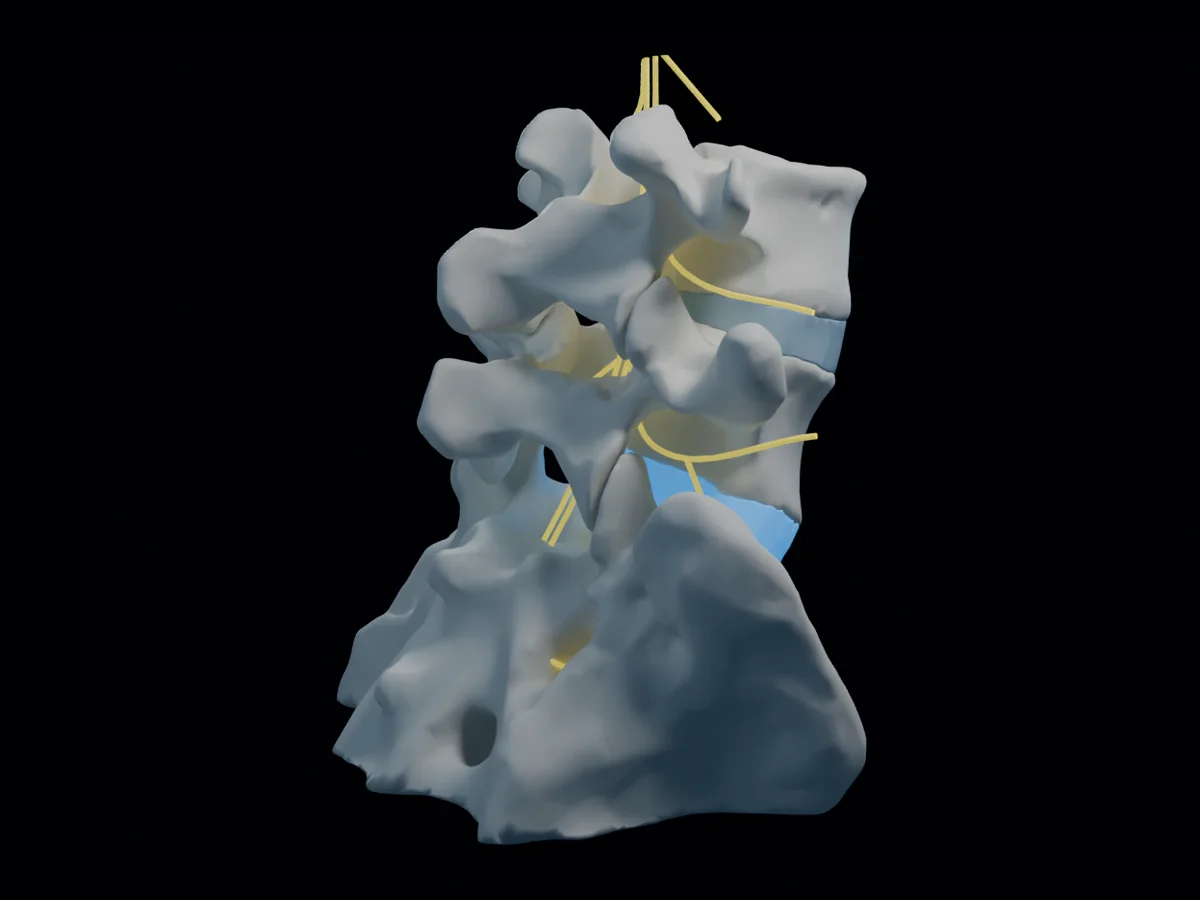
What the model shows: 3D model of the lower back in Julio, showing the L4 and L5 vertebrae and the sacrum, with the L5-S1 disc highlighted in blue and the adjacent nerve roots in yellow. Julio, Team Clinic 360° Anatomical detail: The L5-S1 disc (blue) sits between the L5 vertebra and the sacrum, right next to the nerve roots (yellow) leaving the spinal canal. That is why a bulge or herniation at this level can irritate a nerve root and cause pain that radiates to the buttock and leg. Interaction: this is an interactive 3D model from Julio. Once the 3D view loads it rotates automatically, unless the device is set to reduce motion. Drag to change the viewing angle and examine the anatomy from different sides; after you start interacting you can also zoom in and out.
The L5-S1 disc (blue) sits between the L5 vertebra and the sacrum, right next to the nerve roots (yellow) leaving the spinal canal. That is why a bulge or herniation at this level can irritate a nerve root and cause pain that radiates to the buttock and leg.
Anatomy model from Julio, the Team Clinic 360° digital atlas. Geometry sources: BodyParts3D © The Database Center for Life Science, CC BY-SA 2.1 JP; Z-Anatomy, CC BY-SA 4.0.
What is a herniated disc?
Between the vertebrae of the spine sit discs that absorb load and allow movement. When part of a disc bulges or herniates outward, it can irritate a nearby nerve and cause pain.
In the lower back, a herniated disc can cause back pain, pain radiating to the buttock or leg, numbness, burning or weakness. In the neck, it can cause neck pain, pain between the shoulder blades, pain radiating to the shoulder or arm, numbness or weakness.
But the presence of a finding does not always mean it is the only source of the pain.
When does a herniated disc really explain the pain?
To know whether the disc is the source, we connect three things: your history, the clinical exam and the imaging.
The type of pain gives useful clues. Pain from an irritated nerve root often feels sharp, shooting or electric and travels down the leg along a fairly defined path. Pain coming from the structures of the back itself tends to feel duller and more spread out. The two can overlap, so the pattern is a clue, not a diagnosis on its own.
If the pain follows a clear nerve pathway, there is numbness or weakness, and the MRI shows compression that matches that exact nerve, it is much more likely the disc is involved. If there is a finding on imaging but the pain is diffuse, shifting, more muscular or does not fit a nerve pathway, the source may be different or mixed.
Does a herniated disc require surgery?
Not always. Many herniated discs can be treated with a conservative or combined approach, depending on severity, findings, pain level and function.
There are situations where surgery is the right choice, particularly with significant weakness, neurological deterioration, or a medical condition that requires intervention. There are also many situations where it is right to pause, look more closely, and consider treatment options before a surgical decision. If you are weighing surgery, our second opinion before surgery is built for exactly that.
How we evaluate a herniated disc at Team Clinic 360°
We start with a structured history: when the pain began, where it radiates, what makes it worse or better, what has been tried, and what worries you most.
The clinical exam is aimed at understanding whether a nerve is involved, whether there is weakness, whether the pain follows a specific nerve, and whether there is an additional muscular, joint or functional component.
When needed, we go through your existing CT or MRI together and assess whether the finding fits the clinical picture.
Treatment options for a herniated disc
Treatment can combine:
- Relative rest and guidance on load
- Medication tailored to you, including treatment for nerve pain
- Physical therapy and movement rehabilitation
- Targeted injections and nerve blocks
- Image-guided procedures, in appropriate cases
The aim is to reduce pain, improve function, restore movement and give you a clear plan. Not every patient needs the same treatment, and not every herniated disc calls for the same approach.
When to seek emergency care
Go to an emergency department right away, without waiting for a clinic appointment, if back pain or leg pain comes with any of the following:
- New difficulty passing urine, loss of bladder control, or new loss of bowel control
- Numbness in the groin, genitals, buttocks or inner thighs (the area that would touch a saddle)
- Weakness in a leg or foot that is getting worse quickly, or a foot that suddenly drags
- Numbness or weakness in both legs
These can be signs of severe nerve compression, such as cauda equina syndrome, which needs urgent assessment in hospital.
When should you come in?
Consider an evaluation if you have back or neck pain that radiates to the leg or arm, numbness, burning, pain that is not improving, difficulty functioning, uncertainty about your MRI report, or you are deciding about surgery.
At Team Clinic 360° we bring order to the picture. We do not alarm you, we do not rush into procedures, and we do not dismiss real pain. We examine, explain and build a plan.
Frequently asked questions
In some cases there is significant improvement over time, especially when there is no significant neurological deficit. It is still important to be evaluated when the pain is significant or radiates.
A bulging disc extends beyond its normal boundary. In a herniated disc, inner disc material breaks through outward. In both cases the question is whether the finding actually explains the pain.
When there is significant weakness, neurological deterioration, intolerable pain that is not improving, or a medical condition that requires intervention. The decision should follow a structured medical evaluation.
In many cases, yes. Treatment depends on the clinical picture, the pain level, the findings and the effect on function.
Book a consultation
Not sure whether we are the right place for you? Leave your details and we will get back to you to schedule an evaluation.
Professional sources for further reading
The information on this page is general and does not replace personal medical advice. For transparency, you can also read these outside sources:
This page is general information only and does not replace a personal medical evaluation, advice or treatment. Treatment is chosen only after an individual assessment.