Neck and Upper Back Pain That Won't Go Away
Neck or upper back pain is not always just "a stiff neck." When the pain lasts, keeps coming back, radiates to the shoulder blade or arm, causes numbness, limits movement or starts affecting sleep and work, it is time to stop and find out what is really going on.
Many of the patients we see arrive after a long stretch of pain. Some have tried physical therapy, some have taken pills, some have had an X-ray or MRI, and they still do not have a clear answer. Sometimes the source is in the neck, sometimes in the upper back, sometimes in the shoulder, and often it is a combination of muscles, joints, nerves and daily load.
Our goal is not only to calm the pain. It is to understand where it comes from, look at the whole picture, and build a treatment plan that fits the person in front of us.
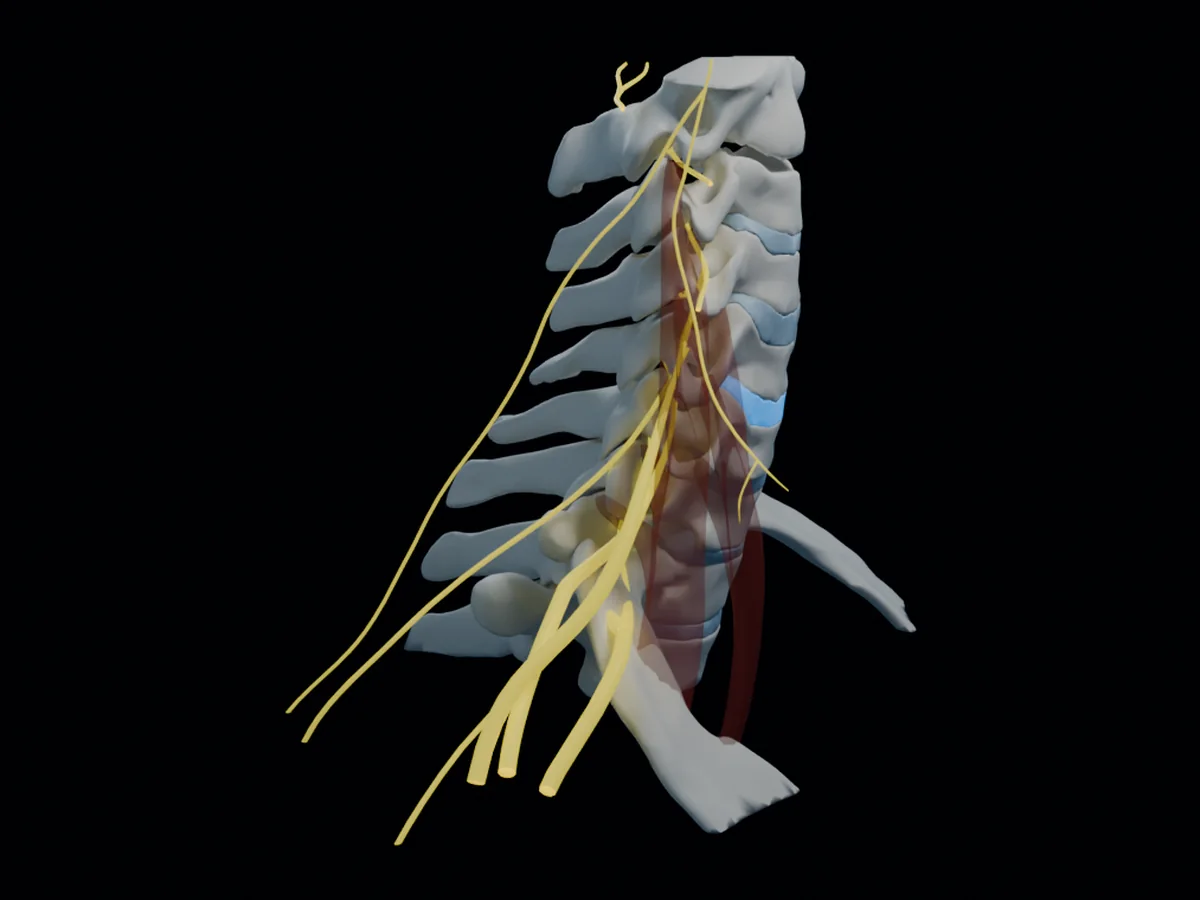
What the model shows: 3D model of the cervical spine from C2 to T2 in Julio, with the C5-C6 disc highlighted in blue, the nerve roots and brachial plexus in yellow and the scalene muscles shown transparent. Julio, Team Clinic 360° Anatomical detail: The cervical spine in Julio. The C5-C6 disc (blue) sits right next to the nerve roots (yellow) that leave the neck between the scalene muscles (semi-transparent) on their way to the shoulder and arm. Interaction: this is an interactive 3D model from Julio. Once the 3D view loads it rotates automatically, unless the device is set to reduce motion. Drag to change the viewing angle and examine the anatomy from different sides; after you start interacting you can also zoom in and out.
The cervical spine in Julio. The C5-C6 disc (blue) sits right next to the nerve roots (yellow) that leave the neck between the scalene muscles (semi-transparent) on their way to the shoulder and arm.
Anatomy model from Julio, the Team Clinic 360° digital atlas. Geometry sources: BodyParts3D © The Database Center for Life Science, CC BY-SA 2.1 JP; Z-Anatomy, CC BY-SA 4.0.
When does neck or upper back pain need a workup?
This pain can follow a bad night's sleep, long hours at a computer, training load, an accident, an injury, stress, physical work, or appear for no clear reason. Often it passes. When it lasts or recurs, it deserves a structured evaluation.
- Pain lasting more than a few weeks, or coming back again and again
- Radiation to the shoulder or arm
- Numbness, burning or weakness
- Headaches, dizziness or pain between the shoulder blades
- Significant restriction of movement
Even when the MRI shows a disc bulge or cervical herniation, the question is whether that finding actually explains the pain. Not every imaging finding is the pain source, and not all neck pain comes from the disc.
What can cause pain in the neck and upper back?
Tight muscles and myofascial trigger points, overloaded neck joints, nerve irritation, a cervical disc bulge or herniation, pain that starts in the shoulder, pain that starts in the upper back and travels to the neck, prolonged posture, computer work, emotional load, or several of these together.
When a cervical nerve root is involved, the pain follows a recognizable path. In our clinical sources, root irritation from a disc is most common at C6-C7 and then C5-C6, and C6 root pain can travel along the outer arm and forearm to the thumb and index finger. That same C6 pattern can mimic carpal tunnel syndrome, which is one reason the exam matters. Pain from the small facet joints of the neck belongs in the differential too.
Good treatment starts with a good diagnosis. Asking "where does it hurt" is not enough. We need to know when the pain appears, where it travels, what makes it worse or better, what has already been tried, and how it affects your life.
Why treatment sometimes does not help
Many patients go through a long path: an orthopedist, an X-ray, an MRI, pills, physical therapy, massage, acupuncture and rest, and the pain is still there.
That does not mean nothing can be done. Sometimes the exact source was simply never identified. Sometimes the disc is treated when the pain comes from a joint or a muscle. Sometimes the muscle is treated when a nerve is involved. And sometimes the neck, upper back, shoulder, sleep, work and overall load are all connected.
That is exactly where a wider view is needed.
How we evaluate neck and upper back pain at Team Clinic 360°
We perform a structured medical evaluation: an in-depth conversation, a clinical exam, a review of previous tests and imaging when needed, and an understanding of the full story. Not only of the neck or the upper back, but of the person.
We look at whether this is muscle pain, nerve pain, joint pain, disc-related pain, pain referred from the shoulder, or pain connected to migraines and headaches.
When appropriate, we add musculoskeletal ultrasound, targeted treatment, ultrasound-guided procedures, tailored medication, physical therapy, rehabilitation and guidance on next steps.
Treatment options
Treatment is chosen by the source of the pain, not by a general diagnostic label.
In some cases the focus is on restoring movement, strengthening, and improving load and work habits. In others, treatment may include nerve pain management, treatment of myofascial trigger points, a targeted injection, a nerve block, an ultrasound-guided procedure, or a combination.
When pain radiates to the arm or comes with numbness or weakness, an accurate medical evaluation is especially important to understand whether a nerve is involved and how best to treat it.
Precise diagnosis, personal treatment
Neck and upper back pain can be simple, and it can also be complex. The difference is in the diagnosis.
At Team Clinic 360° in Herzliya we combine pain medicine, rehabilitation, broad clinical thinking and a human approach. We look at the whole picture: the neck, the upper back, the shoulder, the nerves, the muscles, movement, sleep and life itself.
Frequently asked questions
No. Even when imaging shows a herniation or bulge, it is not always the source of the pain. Pain can come from muscles, joints, nerves, posture, load or a combination.
When there is radiation to the arm, numbness, burning, weakness, or pain that is getting worse over time, a structured medical evaluation is recommended.
Yes. Pain felt between the shoulder blades or in the upper back is sometimes related to neck load, nerve irritation, tight muscles or a combination of neighboring areas.
Yes. In some patients pain that starts in the neck radiates to the back of the head, the temples or behind the eye, or worsens existing headaches.
Book a consultation
Not sure whether we are the right place for you? Leave your details and we will get back to you to schedule an evaluation.
Professional sources for further reading
The information on this page is general and does not replace personal medical advice. For transparency, you can also read these outside sources:
This page is general information only and does not replace a personal medical evaluation, advice or treatment. Treatment is chosen only after an individual assessment.