Migraines and Headaches That Keep Coming Back
Headaches and migraines can disrupt an entire life. Sometimes it starts behind the eye, sometimes at the back of the head, sometimes at the temples, and sometimes it feels like the whole head has locked up. When headaches recur, get worse or stop responding to the usual treatment, the picture needs a closer look.
At Team Clinic 360° we do not treat a headache as a purely local pain. It may be migraine. It may come from the neck, from muscle tension, from an irritated nerve, or from a combination.
The goal is to understand which type of headache you have, what triggers it, what makes it worse, and what can reduce how often it comes, how hard it hits and how much it takes from your life.
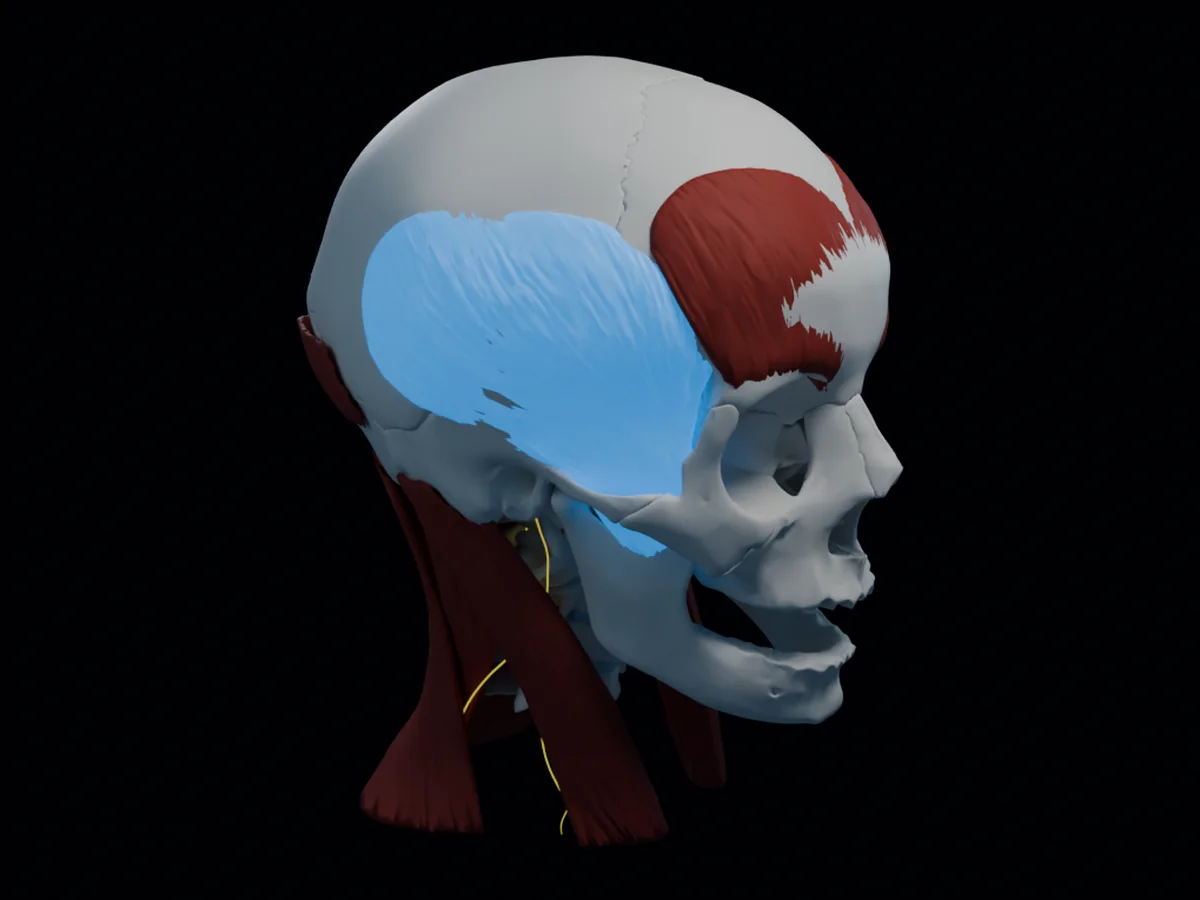
What the model shows: 3D model of the skull and the muscles of the head and neck in Julio, with the temporalis highlighted in blue alongside the frontalis, occipitalis, neck muscles and upper trapezius. Julio, Team Clinic 360° Anatomical detail: The muscles of the head and neck in Julio: the temporalis (blue), the frontalis, the occipitalis, the upper trapezius and the neck muscles. Interaction: this is an interactive 3D model from Julio. Once the 3D view loads it rotates automatically, unless the device is set to reduce motion. Drag to change the viewing angle and examine the anatomy from different sides; after you start interacting you can also zoom in and out.
The muscles of the head and neck in Julio: the temporalis (blue), the frontalis, the occipitalis, the upper trapezius and the neck muscles.
Anatomy model from Julio, the Team Clinic 360° digital atlas. Geometry sources: BodyParts3D © The Database Center for Life Science, CC BY-SA 2.1 JP; Z-Anatomy, CC BY-SA 4.0.
Not every headache is a migraine
Migraine is a real medical diagnosis, but not every recurring headache is migraine. There are headaches that start in the neck, tension-type headaches, nerve-related headaches, headaches tied to the muscles of the neck and the back of the head, and headaches shaped by sleep, stress, diet, load, medication or other medical conditions.
That is why a general label is not enough. We need the pattern: where the pain starts, how long it lasts, whether there is nausea or sensitivity to light or noise, whether there is neck pain or radiation, and what has already been tried.
The neck, the back of the head, and headache
For some patients the headache actually starts in the neck or at the back of the head. It can radiate to the base of the skull, the temples, the forehead or behind the eye.
The trapezius and the small muscles beneath the base of the skull can themselves be a source of neck-related (cervicogenic) headache. The greater occipital nerve, which supplies sensation to the back of the neck and scalp, can become entrapped as it passes between the deep neck muscles.
An accurate diagnosis can change the treatment plan completely, especially for patients who have already tried migraine medications without enough relief.
When should you get evaluated?
Consider an evaluation when your headaches:
- Come back frequently
- Interfere with work or sleep
- Require repeated use of pain relievers
- Start in the neck or come with pain at the back of the head
- Are becoming more frequent or more severe
Any new, unusual or sudden headache, or a headache with neurological symptoms, needs urgent medical attention.
How we evaluate headaches and migraines
We start with a structured conversation about the pain pattern: location, frequency, duration, triggers, previous treatments, medications, sleep, daily load, neck pain and medical history.
The clinical exam includes the neck, shoulders and muscles, range of motion, nerve sensitivity and other signs that help identify the source.
When needed, we review existing tests and imaging and decide together on the right next step.
Treatment options
Treatment depends on the type of headache and its likely source. Sometimes the focus is on adjusting medication, sometimes on neck rehabilitation, sometimes on treating nerve or muscle pain, and sometimes on targeted procedures.
In appropriate cases we may consider ultrasound-guided treatment and nerve blocks. Occipital nerve blocks are used in occipital neuralgia and neck-related headache, and in selected patients with other headaches, including some with migraine. For chronic migraine we also offer a structured botulinum toxin protocol.
For some patients the right plan combines pain medicine, rehabilitation, changes in load, and attention to functional and emotional factors.
Seeing the whole picture
Recurring headaches are not just pain. They affect function, concentration, family, work and quality of life. We are not looking for a quick, shallow fix. We want to understand what is behind the pain and build a clear treatment plan.
Frequently asked questions
Yes. In some patients pain that starts in the neck radiates to the back of the head, the temples, the forehead or behind the eye.
Migraine usually follows a recurring pattern and may come with sensitivity to light or noise, nausea, or worsening with exertion. The diagnosis should be made by a physician.
In some situations, frequent use of pain relievers can become part of the problem. It is worth raising this in a medical evaluation.
Yes. Depending on the diagnosis, treatment can include rehabilitation, treating neck or muscle factors, treating nerve pain, and targeted procedures in appropriate cases.
Book a consultation
Not sure whether we are the right place for you? Leave your details and we will get back to you to schedule an evaluation.
Professional sources for further reading
The information on this page is general and does not replace personal medical advice. For transparency, you can also read these outside sources:
This page is general information only and does not replace a personal medical evaluation, advice or treatment. Treatment is chosen only after an individual assessment.