Frozen Shoulder
When your shoulder hurts, your arm won't lift, and time alone isn't enough
Frozen shoulder is one of the most frustrating causes of shoulder pain.
At first it can feel like a small catch with one particular movement. Then it gets hard to lift your arm. Hard to reach a shelf. Hard to get dressed. Hard to reach behind your back. Hard to sleep on that side. And at some point, even simple movements turn into a struggle.
Many patients are told: "It will go away on its own." "You just need physical therapy." "There is nothing to do, it just takes time."
Sometimes that is partly true. But with frozen shoulder, the important question is not only whether it will pass. It is how long it will take, how much pain you will go through, how much motion you will lose, and whether the right intervention can improve the course.
At Team Clinic 360° we treat frozen shoulder as a condition that calls for an accurate diagnosis, an understanding of the stage of the disease, and the right balance between pain, motion and rehabilitation.
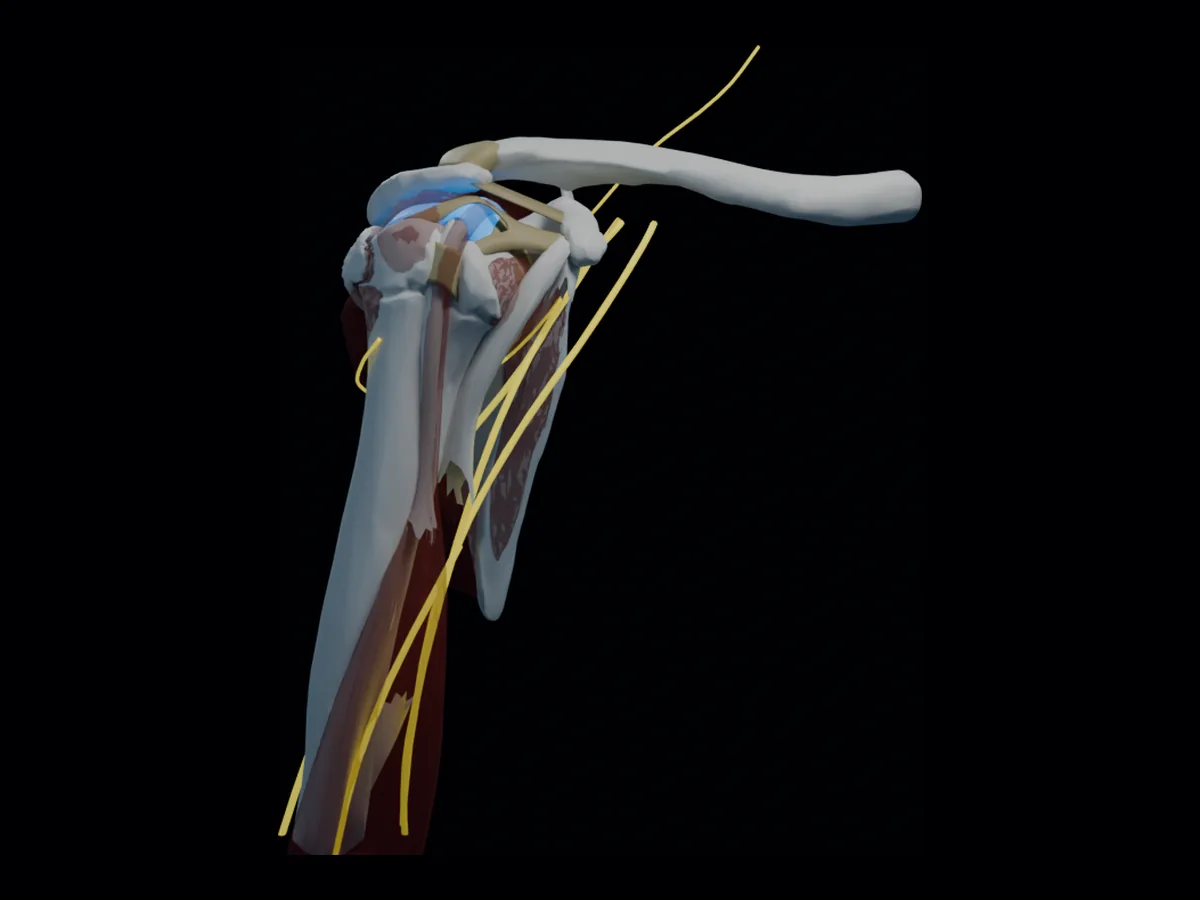
What the model shows: 3D model of the right shoulder in Julio: the scapula, clavicle and humerus, with the shoulder joint capsule highlighted in blue, the surrounding ligaments, the rotator cuff muscles shown transparent, and the axillary and suprascapular nerves. Julio, Team Clinic 360° Anatomical detail: In blue: the shoulder joint capsule, the sleeve that encloses the joint between the head of the humerus and the socket of the shoulder blade. In frozen shoulder it thickens and loses its flexibility. The rotator cuff muscles are shown transparent so the capsule can be seen. Interaction: this is an interactive 3D model from Julio. Once the 3D view loads it rotates automatically, unless the device is set to reduce motion. Drag to change the viewing angle and examine the anatomy from different sides; after you start interacting you can also zoom in and out.
In blue: the shoulder joint capsule, the sleeve that encloses the joint between the head of the humerus and the socket of the shoulder blade. In frozen shoulder it thickens and loses its flexibility. The rotator cuff muscles are shown transparent so the capsule can be seen.
Anatomy model from Julio, the Team Clinic 360° digital atlas. Geometry sources: BodyParts3D © The Database Center for Life Science, CC BY-SA 2.1 JP; Z-Anatomy, CC BY-SA 4.0.
What is frozen shoulder?
Frozen shoulder, or adhesive capsulitis, is a condition in which the capsule of the shoulder joint becomes stiff, inflamed and tight. The result is pain and a significant loss of motion in the shoulder. According to the AAOS, frozen shoulder causes pain and stiffness, and over time the shoulder can become very hard to move.
What makes frozen shoulder distinct is that it is not only about pain. It is a combination of pain, stiffness and lost motion.
In other painful shoulder conditions, a patient may be unable to raise the arm because of pain or weakness. In frozen shoulder, even when someone else gently tries to move the arm, the motion itself is restricted.
And that is an important sign.
What does frozen shoulder feel like?
Patients with frozen shoulder often describe:
- Deep pain in the shoulder
- Pain that worsens at night
- Difficulty sleeping on that side
- Difficulty raising the arm overhead
- Difficulty reaching behind the back
- Difficulty dressing, combing hair or fastening a belt
- Sharp pain with sudden movement
- A gradual decline in range of motion
- A sense that the shoulder is "locked"
- Fear of moving the arm because of pain
The NHS describes the two main signs of frozen shoulder as shoulder pain, which can be worse at night and disturb sleep, and stiffness that makes the shoulder hard to move.
But beyond the medical definition, there is a real, everyday cost. Frozen shoulder can affect work, training, sleep, driving, dressing and your sense of independence.
Why does an accurate diagnosis matter?
Not every shoulder pain is a frozen shoulder.
Shoulder pain can come from tendons, a bursa, the neck, a nerve, the joint itself, a tendon tear, inflammation, muscular overload or myofascial pain. Sometimes a patient arrives with a diagnosis of frozen shoulder, but the exam points to a different problem. And sometimes the opposite happens - a patient is treated for months as "shoulder inflammation," while the picture actually fits frozen shoulder.
The difference matters, because the treatment is not the same.
With frozen shoulder we need to understand: Are we in a very painful stage? Are we in a stiffer stage? Is there an inflammatory component? Is there an additional problem in a tendon or in the neck? Is the patient a candidate for an injection, ultrasound-guided treatment, gentle physical therapy, or a different plan?
An accurate diagnosis saves time, pain and treatments that do not fit the stage the patient is in.
The stages of frozen shoulder
Frozen shoulder usually develops gradually, and often moves through different stages:
Stage one - the painful stage
Pain builds over time. Motion starts to become limited, but the pain is the most prominent feature. Nights can be especially hard.
Stage two - the frozen stage
The pain sometimes eases a little, but the stiffness becomes more prominent. The shoulder is limited, the arm does not rise the way it used to, and everyday movements become difficult.
Stage three - the thawing stage
Gradually, motion can begin to return. But this can take a long time, and some limitation may remain if it is not managed well.
Leading medical sources describe frozen shoulder as something that can last months and sometimes years, with full recovery taking a long time. The AAOS notes that full recovery can take up to three years, and the NHS describes a condition that can last months or years.
That is exactly why it is not a good idea to wait without understanding what is going on.
Why "waiting for it to pass" is not always enough
It is true that frozen shoulder can improve over time. But time alone is not a treatment plan.
While waiting, a patient may go through significant pain, poor sleep, declining motion, an impact on work, and a growing tendency to avoid using the arm.
More than that - the wrong treatment at the wrong stage can make pain worse. Physical therapy that is too aggressive in the painful stage can cause a patient to stop treatment altogether. On the other hand, complete avoidance of movement can deepen the limitation.
That is why treatment has to match the stage.
In the painful stage - first control the pain and allow safe movement. In the stiff stage - work gradually on range of motion. In the thawing stage - rebuild function, strength and confidence in movement.
Our approach at Team Clinic 360°
At Team Clinic 360° we do not look at frozen shoulder as just another "painful shoulder."
We look at the whole picture:
- How the pain began
- How long the limitation has been present
- Which movements are affected
- Whether the pain wakes you at night
- Whether there is diabetes, thyroid disease or relevant medical history
- Whether there was an injury, surgery or a period of not using the arm
- Whether there is pain coming from the neck or radiating into the arm
- Whether there is a suspected problem in the tendons, bursa or joint
- What treatment has already been tried and how it responded
The exam includes looking at range of motion, pain, strength and function, and at times the use of ultrasound based on clinical need.
The goal is not just to say "this is a frozen shoulder." The goal is to understand which stage it is in, what else is involved, and the right way to move forward.
The value of a pain physician in frozen shoulder
In frozen shoulder, pain is not a minor detail. Pain is often what prevents motion, sleep, treatment and rehabilitation.
This is where the value of a pain physician comes in.
A pain physician can help determine whether the source of pain is mainly joint-related, inflammatory, neural, muscular or mixed. They can assess whether there is a role for medication, an injection, ultrasound-guided treatment, a nerve block, or a combination with physical therapy and rehabilitation.
Put simply: to restore motion, sometimes you first have to bring the pain down enough for the body to agree to move.
Treatment for frozen shoulder
Treatment for frozen shoulder depends on the stage, the intensity of pain, the range of motion, the medical background and the patient's goals.
In most cases treatment will combine pain control, movement practice, gradual rehabilitation and at times an interventional treatment. The Mayo Clinic notes that treatment usually involves range-of-motion exercises, and sometimes corticosteroid and numbing medication injected into the joint; surgery is rarely needed.
In suitable cases, treatment options may include:
- Assessment by a pain physician
- Clinical evaluation of range of motion
- Diagnostic ultrasound as needed
- Medication to reduce pain and inflammation, when appropriate
- A shoulder injection in suitable cases
- Ultrasound-guided treatment for greater accuracy
- Physical therapy matched to the stage of the disease
- A gradual home program
- Working to restore motion without flaring the pain
- Looking at additional contributors such as the neck, a nerve, tendons or myofascial pain
There is no single treatment that fits everyone. There is a shoulder. There is a stage. There is a person. And there is a plan that has to fit them.
Injections and ultrasound-guided treatment
When there is significant pain or difficulty starting rehabilitation, there is sometimes a place to consider a shoulder injection or ultrasound-guided treatment.
The advantage of ultrasound is the ability to see the area in real time and direct the treatment more precisely, according to the anatomy and the therapeutic goal.
Not every patient needs an injection. And not every frozen shoulder is suited to the same treatment. But when chosen well, a treatment like this can be a meaningful part of a plan aimed at reducing pain and allowing a gradual return to motion.
Precision matters. Especially when the goal is not just "to do an injection," but to integrate it within the right medical and rehabilitative plan.
Frozen shoulder or a tendon tear?
Many patients worry about a tendon tear. Others are sure it is inflammation. Some arrive after an X-ray or ultrasound showing a tendon finding, but it is still unclear whether that explains all of the pain.
The difference between frozen shoulder and a tendon tear is very important.
With a significant tendon tear, there is sometimes notable weakness or difficulty activating the arm. In frozen shoulder, the central problem is restricted motion of the joint itself. And sometimes there is both - a frozen shoulder together with a tendon problem.
That is why it is not enough to look at one test alone. You have to examine the patient, the motion, the pain, the imaging and the function together.
Frozen shoulder and the neck
Sometimes shoulder pain does not start in the shoulder.
Pain coming from the neck can radiate to the shoulder and arm. Neural pain can cause burning, numbness, electric sensations or weakness. Myofascial pain from the neck and shoulder blades can feel like deep shoulder pain.
In cases like these, treating the shoulder alone will not always solve the problem.
That is why, in our exam, we do not stop at the shoulder. We ask whether the neck, the nerves, the muscles and the shoulder blades are part of the picture.
Because sometimes the shoulder is frozen. And sometimes it only looks frozen because of pain coming from somewhere else.
When should you come in for an evaluation?
It is worth considering a visit to a pain physician or a clinic that focuses on shoulder pain if:
- The pain has lasted more than a few weeks
- Range of motion is shrinking
- It is hard to lift the arm
- It is hard to reach behind your back
- The pain disturbs sleep
- Physical therapy made the pain worse or did not progress
- There are different diagnoses and it is unclear which is correct
- You were told to "wait for it to pass," but function keeps declining
- You have diabetes, thyroid disease or a medical background that raises the risk of frozen shoulder
- There is concern about a combined problem - shoulder, neck, nerve or muscle
StatPearls notes that frozen shoulder is more common among middle-aged adults, and especially in people with endocrine disorders such as diabetes or thyroid problems.
What happens at the appointment?
At the appointment we carry out a medical evaluation aimed at understanding whether this is a frozen shoulder, which stage it is in, and whether other factors are involved.
The appointment may include:
- An in-depth medical conversation
- Examination of active and passive range of motion
- Assessment of strength and function
- Examination of the neck, shoulder blades and radiating areas as needed
- Review of ultrasound, MRI, X-ray or previous tests
- Assessment of whether there is an inflammatory, muscular, neural or joint component
- Evaluation of suitability for medication, injection, ultrasound-guided treatment or rehabilitation
- Building a clear treatment direction
The goal is for you to leave with an understanding: what is probably happening in the shoulder, what stage the problem is in, and what can be done now.
Why Team Clinic 360°?
Because frozen shoulder takes more than saying "go do physical therapy."
It takes a diagnosis. It takes an understanding of pain. It takes knowing when not to push too hard. When to move forward. When to consider an injection. When to check the neck. And when to recognize that the shoulder is only part of a wider story.
At Team Clinic 360° in Herzliya we bring together precise medicine, pain treatment, ultrasound, rehabilitative thinking and a human approach.
We do not just treat a shoulder. We treat the person whose shoulder put their life on hold.
What to bring to the appointment
We recommend coming with:
- Previous visit summaries
- Ultrasound / MRI / X-ray reports, if you have them
- A disc or link to imaging
- A list of medications and treatments you have tried
- A short summary: when the pain started, what makes it worse, what eases it, and what you can no longer do
- Records of physical therapy, injections or previous treatments, if any
Frozen shoulder - you do not have to wait it out alone
Frozen shoulder can be a long, painful and limiting process. But even within that process, an accurate diagnosis and the right treatment at the right time make a real difference.
If your arm will not lift, the pain disturbs your sleep, your motion keeps disappearing, or treatments so far have not given a clear direction - it is worth stopping and looking at it properly.
At Team Clinic 360° we will examine the shoulder in depth, find out what is truly limiting the motion, and build a treatment plan matched to your stage, your pain and your function.
To schedule a medical evaluation for frozen shoulder - leave your details and we will get back to you shortly.
Frequently asked questions
Does frozen shoulder go away on its own?
Frozen shoulder sometimes improves over time, but the process can last months and even years. The right treatment can help with pain control, preserving motion and a gradual return to function.
How do you know if it is frozen shoulder or shoulder inflammation?
Frozen shoulder usually involves a significant loss of range of motion, including when someone tries to move the arm passively. With inflammation or a tendon problem, the pattern of limitation can be different. That is why a clinical exam matters, rather than relying on the feeling of pain alone.
Does physical therapy help frozen shoulder?
Yes, but it is important to match the physical therapy to the stage. In a very painful stage, overly aggressive treatment can worsen pain. At the right stage, gradual range-of-motion work is a central part of rehabilitation.
Can an injection help?
In suitable cases, a shoulder injection can help reduce pain and allow a better start to motion rehabilitation. The decision depends on the exam, the stage of the disease and the medical background.
Is surgery required for frozen shoulder?
In most cases, no. According to the Mayo Clinic, surgery is rarely needed, and is aimed at releasing tissue that restricts the joint's motion.
Is frozen shoulder related to diabetes?
Yes. Frozen shoulder is more common in people with diabetes, and can also be associated with thyroid problems and other medical conditions.
Can neck pain look like frozen shoulder?
Yes. Neck pain, neural pain or myofascial pain can radiate to the shoulder and confuse the picture. That is why the exam should also address the neck, the shoulder blade, the nerves and the pain pattern.